


Digital height gauge
Digital Height Gauges and Their Role in Modern Manufacturing
In mechanical workshops, precision machining areas, and Quality Control (QC) laboratories, the digital height gauge is an essential daily tool. Compared to traditional mechanical versions, digital models enable faster dimensional control, offer superior readability, and reduce reliance on an operator's individual experience.
EMIN currently distributes a wide range of digital height gauges from leading global brands, most notably Mitutoyo and Insize. These brands are extensively used in factories, machining shops, and Foreign Direct Investment (FDI) enterprises, where strict dimensional control according to technical drawings is mandatory.
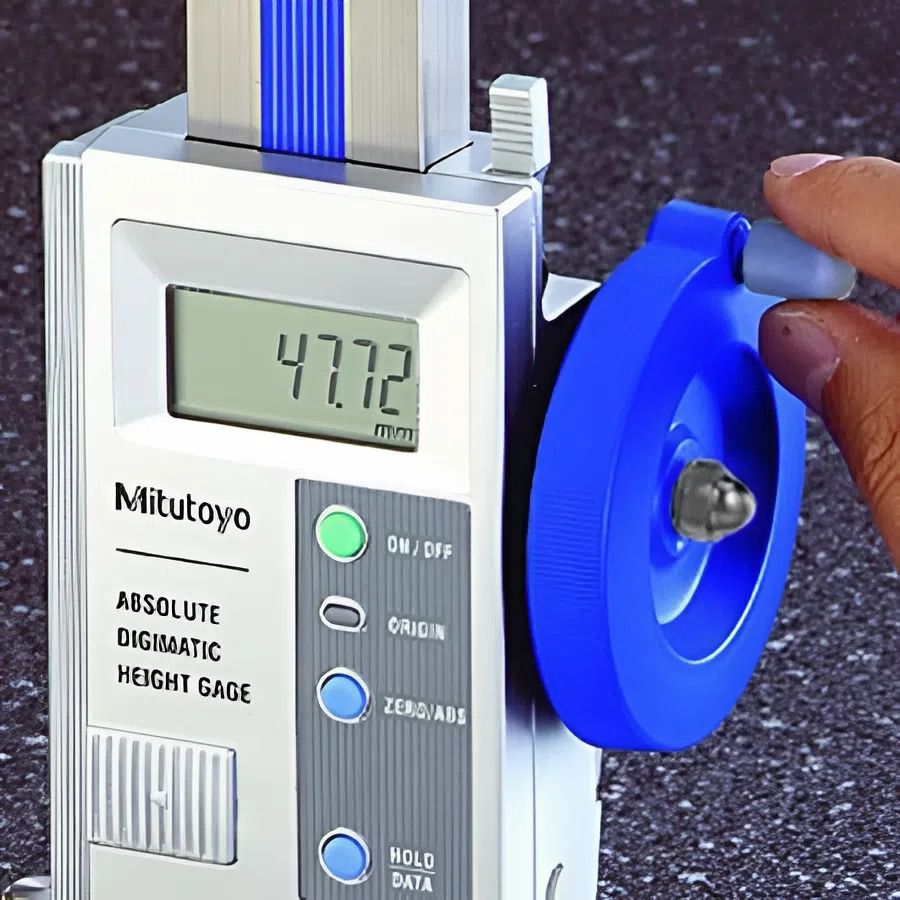
How Digital Height Gauges Operate on Surface Plates
The basic structure consists of a main column, a slider, and a digital display unit. The measuring beam is typically crafted from stainless steel to ensure high rigidity and long-term dimensional stability. A linear sensor records the slider's movement and converts it into numerical values displayed on the screen.
During the measurement process, the probe makes direct contact with the workpiece surface or a measurement standard. Value changes are reflected instantly, allowing operators to perform continuous inspections without pausing to read manual scale graduations.
Why Digital Height Gauges are Preferred in Workshops
Compared to traditional mechanical gauges, digital displays significantly reduce errors caused by parallax or misreading scale lines. The rapid response time supports repetitive measurements, making it ideal for batch production environments or mass inspections.
Several models distributed by EMIN feature unit conversion, flexible zero-setting (origin), and data output capabilities to computers. These features are particularly beneficial for QC departments that require data logging for comparison, reporting, or tracking deviations across different production stages.
Related Content:
3 Common Mistakes Leading to Inaccurate Depth Measurements
Why Digital Height Gauges Remain Widely Used in the Industrial and Mechanical Sectors
Practical Applications Across Key Industries
In the field of precision engineering, digital height gauges are used to verify component heights, surface flatness deviations, and assembly clearances. In electronic component assembly lines, they assist in checking pin dimensions and surface uniformity post-processing.
The metalworking industry utilizes these gauges to evaluate flatness, step heights, and tolerance compliance. Insize models are frequently selected due to their diverse configurations, catering to both medium and large-scale workshops.
Key Considerations for Selection
When choosing a gauge, the following factors should be considered:
Measuring Range: Must be compatible with the standard size of the workpieces being inspected.
Resolution: Should align with actual design tolerances to avoid unnecessary over-investment.
Material Quality: The build material directly affects durability in environments prone to oil, metal dust, or vibrations.
Advanced Features: Functions such as data memory, connectivity, and unit switching provide a distinct advantage for intensive quality inspection units.
The Mitutoyo and Insize digital height gauge series provided by EMIN currently meet these rigorous requirements across various market segments.
-
-
-
-
-
-
-
-
-
-
-
-
-
-
-
-
-
-
-
-
-
-
-
-